

Carbon Credits Management System
Turn kWh into dollars
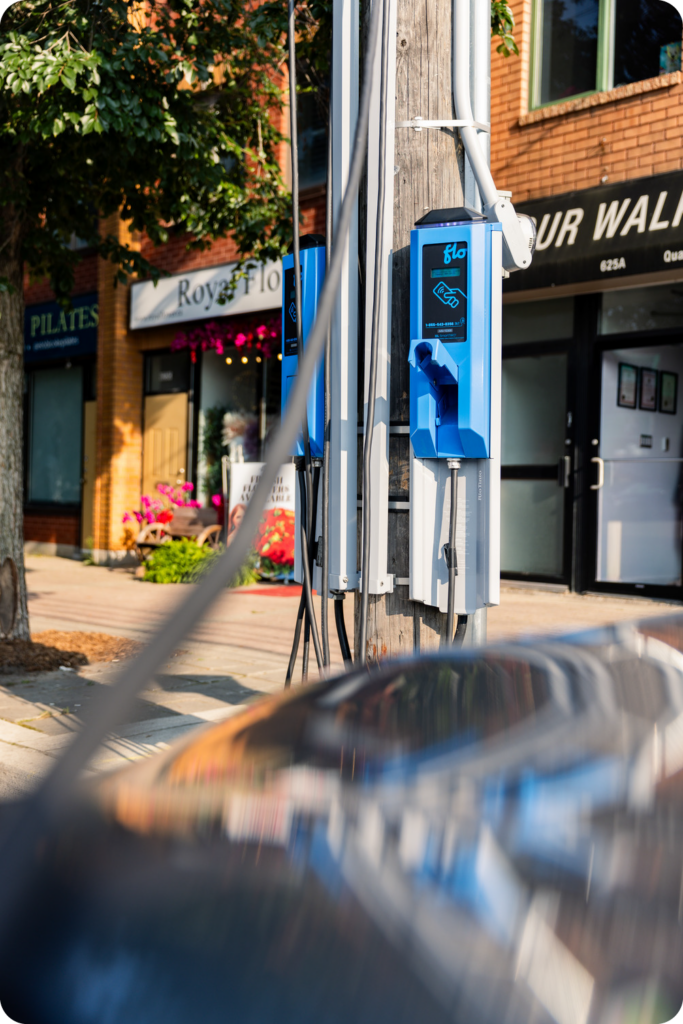
FLO has partnered with FuSE to create the Carbon Credits Management Service (CCMS), which allows EV charging station owners to turn kilowatt-hours into dollars. Let us help you turn usage into income.
- Accelerate your ROI – By quantifying the greenhouse gas (GHG) emissions avoided with EV chargers, you can generate carbon credits and sell them, maximizing your return on investment.
- A streamlined experience – No paperwork, no hassle. FLO and FuSE manage everything on your behalf—from reporting to transacting—so you can enjoy recurring revenue without added work.
- Offset installation costs – Carbon credit earnings can help reduce the ongoing costs of deploying EV charging infrastructure, making your clean energy investment more affordable.

How to earn and monetize credits?
Getting started is easy. With FLO’s CCMS, site owners can unlock new revenue by monetizing their network-connected EV charging stations. Here’s how it works:

Step 1: Evaluate eligibility
FLO will assess your site’s eligibility based on local carbon credit regulations. Eligibility depends on charger type, location, and usage patterns, which can vary by province.
Step 2: Start earning credits
Earn carbon credits every time someone uses your charger. FuSE aggregates credits from thousands of sites and trades them on the open market, maximizing value through volume.

Step 3: Receive your reward
You’ll receive annual payments for your earned carbon credits, minus any applicable service fees and commissions.
Monetize your impact
Effortless carbon credit management for EV chargers
We’ve partnered with FuSE to help applicable EV charging station owners unlock the full value of their investment. FuSE enables EV charging stations owners to monitor and track the carbon credits they generate and trade—measured in metric tons of CO₂ equivalent (MT/CO2e)—and view detailed revenue insights.
Estimate your EV charging carbon credit revenue
Curious how much you could earn from carbon credits by operating EV chargers? Just enter your location, equipment type, and energy use to get an instant estimate of your potential annual earnings.

British Columbia’s Low Carbon Fuel Standard (BC-LCFS)
British Columbia’s Low Carbon Fuel Standard rewards low-carbon transportation fuels like electricity for EVs. Charging station owners earn credits based on electricity’s carbon intensity and they can sell them to fuel suppliers. Revenue must support EV adoption or infrastructure, boosting clean transport while aligning with BC’s climate goals.
Canada Clean Fuels Regulation
The Clean Fuel Regulations (CFR) is a national program designed to reduce greenhouse gas emissions across Canada by encouraging the use of advanced vehicle technologies, like electric vehicles. Under the CFR, private EV charging stations, such as those at workplaces or fleet depots, can generate carbon credits for site owners.

Frequently Asked Questions
If you operate EV charging stations, you may be eligible to earn carbon credits. Our FAQ breaks down what you need to know so you can take full advantage of this opportunity.
What are carbon credits?
Carbon credits are tradable permits that represent the reduction or removal of one metric ton of carbon dioxide (CO₂) or equivalent greenhouse gases. They can be earned by reducing emissions, including by powering electric vehicles (EVs).
How are the carbon credits calculated?
Credits are calculated based on the amount of energy (kWh) delivered to electric vehicles, the carbon intensity of the electricity used, and the displacement of gasoline or diesel usage. Carbon intensity refers to the amount of greenhouse gas emissions produced per unit of electricity, and this varies significantly across provinces. For example, British Columbia’s electricity is primarily hydro-powered and thus has very low carbon intensity, whereas electricity produced through greater use of fossil fuels will have higher carbon intensity.
Can I earn carbon credits through both federal and provincial programs?
Yes. Canada’s national Clean Fuel Regulations (CFR) is stackable with provincial programs, so in provinces like British Columbia, you can claim carbon credits under both the federal CFR and the provincial Low Carbon Fuel Standard (LCFS).
What are the requirements to earn carbon credit from EV charging?
Requirements vary by program but typically involve verified energy usage data, proof of electricity supplied to EVs, registration and reporting through official credit systems.
Can home chargers earn carbon credits?
In British Columbia, condo boards and apartment operators with more than 5 chargers can claim carbon credits under the Low Carbon Fuel Standard (LCFS).
In other provinces, only the network operator can claim carbon credits from home chargers under Canada’s national Clean Fuel Regulations (CFR).
How much is a carbon credit worth?
The worth of a carbon credit can vary significantly depending on several factors: market conditions (supply, demand, and regulatory changes), the region/jurisdiction (e.g., Canada’s Clean Fuel Regulations vs. California’s LCFS), etc.
You can find the current credit pricing and data on FuSE’s website here.
What are the benefits of working with FLO versus directly with an aggregator?
FLO manages the referral and coordinates all necessary reporting directly with FuSE, providing a streamlined, hassle-free experience for site owners. There’s no separate cost to join FLO’s Carbon Credit Management Service.
Who can claim carbon credits for EV charging?
Under Canada’s national Clean Fuel Regulations (CFR), eligibility to claim carbon credits depends on the type of EV charging deployment. For residential and public charging stations, the network operator typically holds the right to claim the credits. In contrast, for private EV charging stations such as those at workplaces or fleet depots, the site owner can claim the credits, provided the chargers are network-connected and meet reporting requirements. For more information, please refer to the regulations available here.
Under British Columbia’s Low Carbon Fuel Standard (LCFS), carbon credits can be earned from EV charging, but eligibility depends on the type of deployment. Site owners can claim the credits for public and private network-connected charging stations. For residential buildings, condo boards and apartment managers may claim credits if they install 5 or more EV charging stations. If a building has fewer than 5 charger, the utility typically retains the right to claim the credits.
Related Resources



Power your community
Schedule a consultation with a FLO expert today!
One of our experienced sales consultants will provide you with all the knowledge you need to electrify your community.
FLO operates one of the largest EV charging networks in North America for drivers to plug in wherever they are: at home, work or on the go.
© 2026 Services FLO Inc. All Rights Reserved.
|Privacy Policy|Website Terms Of Use|Driver Terms of Use